
Hi friends. It’s been a few months since my last blog, and perhaps some of you are starting to assume I need more steam. That is half true. When I started this journey, I agreed with myself that I would approach it as an outlet, not another job. So please do not expect any routine or schedule. So far, I have written about things as they spring up inside me.
Aside from that excuse, I have been busy putting the finishing touches on my first book. This has been a project for about a year, and while it has consumed less time than I feared, it did consume more energy. I have always been a weirdo in how I work. At the beginning of a project, I have a loose idea of what I am trying to achieve, and I am prone to start big things with little loose ideas. My company was that way, and over ten years, the vision sharpened very distinctly. As the vision sharpens in my projects, I can allow and depend on others to help more.
That is how it’s been with the book. The synopsis of the book has changed almost 180 degrees!
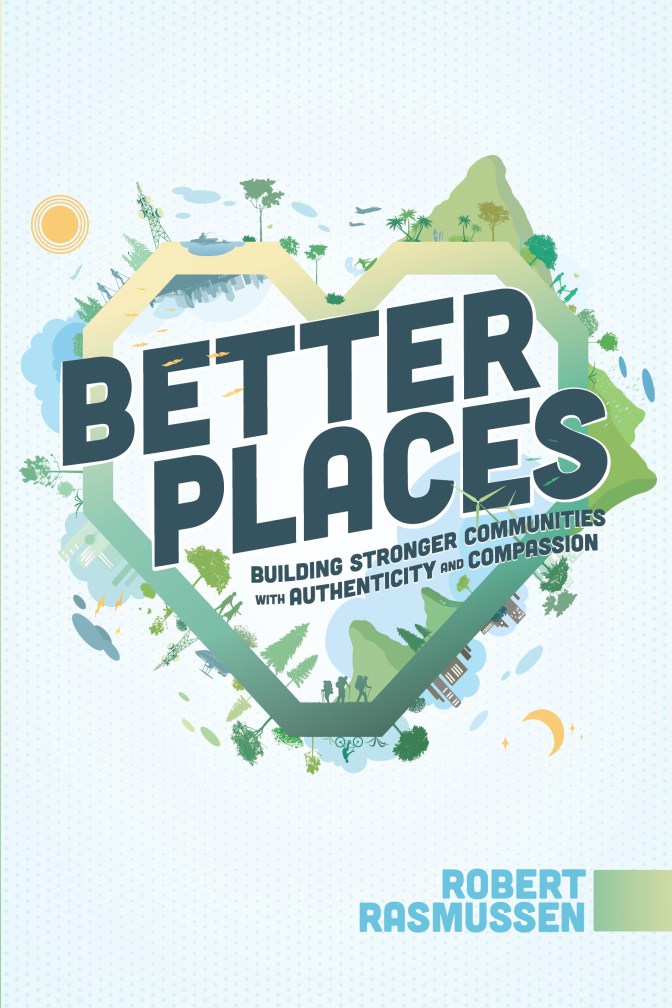
So now that I am 90% done and have 90% of a vision, I will share it with you. My book, which is scheduled for release in September, is called Better Places. It is my story told through the lens of my life’s work (what I feel is inside me to give to the world). I am unsure how unique my message is, but I can tell you that over my 53 years on this planet, it has finally sharpened to a form I can articulate. It is this:
Everyone is born with something organically placed inside that the world needs us to bring forward. Too often, that is replaced with fear and competition (especially in individualistic and violent communities). And we all suffer.
We must embrace our organic nature (authenticity) and replace our aggression with compassion. When we do, we will sense what is happening organically all around us and release what is inside us, what is truly our nature and our destiny.
As I removed my masks, it was easier to see this and help others do so. Agile Six and the coalition and community we built are organic, sensory communities where we respond to each other in compassion and organically unfold abundance instead of competition and planning for scarcity.
As I have journeyed, I have met many like-minded people who do the good work of emancipating people from the social constraints of a violent and competitive society, social constraints like bias, paternalism, nationalism, pride, fear, artificial scarcity and misguided competitiveness. But the most influential people in my life were those I met abroad. This is not because they were more intelligent, enlightened, or kind. It was because they wore different masks. In living abroad, I was encouraged to remove masks unique to our culture, like rugged individual or American patriot, Republican, or Navy Veteran. Those masks did not benefit me any longer. Read my book to learn more about the masks I was asked to pick up.
When my family returned to the US, one of the first things we noticed was that people wanted us to put these masks back on. Our unique journey made it more evident to us to hear the requests people made to identify with them. My son was starting high school and was asked for his preferences immediately. Who are you?
Are you an athlete, a musician, a gamer, or an academic? Often, these queries came in forms that could have been interpreted as, “Where do you wish to compete?” or for which team or club can we sign you up? To his credit, my son really never had good answers. He might have fit in if there was a competition or club for children raised abroad in third cultures or a Norwegian club. And I do not think Kevin ever really fit in high school. I suspect perhaps American high schools excel in the identification and issuing of masks.
I was also asked to wear masks when I settled into my new professional role. Fortunately, professional masks are more global, so the role of project manager and/or department manager was easier for me to assume. But the constitution or components of those masks no longer seemed to fit me either. I heard in various ways that I needed to conform more to the roles. I was not manipulative enough; I was too inclined to adopt the egalitarian values I had learned abroad; I was not the image of the manager that my managers wanted me to reflect. I recall once sitting in a formal performance review and being told by my CEO that I was “frumpy”. You mean my clothes, I asked? Well, yeah, that too, but he said you’re just frumpy. I went to HR afterwards, not to complain but to ask for a definition of this word. She was somewhat stumped as well.
That year, at the age of 43, I got braces, tried to lose a little weight, revamped my wardrobe and tried to remember to tuck in my shirt.
But honestly, the frumpy me was also frumpy inside. After ten years abroad, I was not the sharp and chiselled image of an executive that my leadership wanted. I did not have all the answers, bold plans to execute, or directive orders to shout edicts from my ivory tower. But I could draw on the masks I had picked up abroad. They fit me better.
More importantly, I started to leave the masks off. I dared instead to spend time with myself and learned to like that guy. Even as my teams and projects yielded terrific human experience, growth and profitability outcomes, my leaders still judged me as a bad fit. Or at least that is what I heard from them. So, I changed jobs and eventually realized I had to start my own firm. Many people came with me, and for that, I am humbled. All of us who walked that path together were attracted to the idea of a life without masks. They followed the frumpy guy simply because they could see him around the masks.
As we emancipate people from their masks, we should be patient. We should understand that our society (and all societies) are built on masks. Our schools are in the business of handing them out, and our companies reinforce them with hierarchies. As we go about the work of social change, let’s always remember we do this through the masks we are assigned. Recognize and remove the masks as you feel comfortable. I often hear and believe that humans want to be seen, heard and valued, But first, we must see, hear and value ourselves. Inclusion starts in the mirror.

 Better Places
Fantastisk godt skrevet. Jeg gleder meg til å lese mere. Der du skriver om er også aktuelt i Norge. Det å se seg selv i speilet, og like det du ser og det du er. Vi nordnorske er et folkeslag som er glad i å ta vare på hverandre. Vi spør aldri hvilken jobb eller tittel folk har, vi spør hvem er du datter eller sønnen til. Vi vil gjerne også vite hvilket forhold andre har til vår landsdel. Og vi er stolte av hverandre i Nord Norge på tvers av ytre masker. Og vi tør å si fra, mene, og stå opp for alle våre verdier. Og vi bryr oss ikke så mye om hvordan mennesker ser ut, det viktigste er at de rundt oss oppfører seg og at vi alle har det bra på hvert vårt vis. Vi lærer tidlig at alle er like mye verdt. Og vi setter pris på de som får til ting. Og vi hjelper hverandre. Og du Robert og ÅseLill hadde glidd rett inn hvis dere hadde bosatt dere i Nord Norge. Boka di blir sikkert superbra, for det er en superbra mann som har skrevet den med støtte fra sin søte kone.
Ønsker deg lykke til. Og lag deg en fin dag for det skal jeg. ❤️😊👍🫶
LikeLike
Takk, Irene! Beklager at jeg er sen med å svare – jeg overså dine generøse og vennlige kommentarer tidligere. Du er alltid en så omtenksom og bevisst person. Jeg beundrer det og er takknemlig for vennskapet ditt.
LikeLike