
And I Mean Everyone.
My niece texted me last night with an app idea. A year ago, I would have told her to look into coding bootcamps, maybe start with some YouTube tutorials on Python, and check back in six months. Instead, I told her this: write a 3–5 paragraph description of what you want the app to do, give it to Claude or ChatGPT, and ask it to create a prompt for Replit. That’s it. That will get her 90% of the way to a working app. The remaining 10% won’t be bugs or broken code — it’ll be gaps in her description that she didn’t think through yet. The AI will surface those gaps for her, and she’ll fill them in plain English. They will iterate this dialogue together until it looks like what she wants. Then, together, we will talk about publishing options.
I’m not speaking theoretically. Nine months ago, I jumped into this world with limited traditional development background. Since then, I’ve built eleven apps. Eleven. And I’ve watched the process get dramatically easier with each one — not incrementally easier, but qualitatively different. What used to take me a full weekend of fumbling now takes an afternoon of focused conversation with an AI.
But something shifted in the last few months that I need people to understand. This isn’t just “easier.” It’s accessible. As in, truly open to anyone who can describe what they want in plain language.
It’s Easier Than Software You Already Use
I’m going to make a claim that will sound absurd to some people: building an app with Replit is easier than learning Microsoft Word at an intermediate level, and it’s significantly easier than becoming competent in Excel. I’m not being provocative for the sake of it. Think about what Excel actually demands of you — nested formulas, pivot tables, VLOOKUP logic, conditional formatting rules. That’s a genuine learning curve with abstract syntax and unforgiving error messages. Now think about what Replit asks of you in 2026: describe what you want. The interface looks like ChatGPT or Google. You type. It builds. You refine. It rebuilds. When you’re ready, it deploys.
So why isn’t this on every desktop? Why isn’t everyone doing it?
The Technology Is Outrunning Our Awareness
The first reason is pure speed. This space is evolving faster than any of us can fully absorb. Over the past year, Anthropic and others have introduced systems where “AI agents” supervise and develop each other. The models are learning to serve us faster than we can embrace them. By the time you read a tutorial from three months ago, the workflow it describes may already feel quaint.
The second reason is more subtle, and it’s nobody’s fault, but it matters: there’s an unintentional form of gatekeeping happening from the tech community. Not malicious gatekeeping — just a natural consequence of the fact that engineers see these tools from the backend, and the backend looks increasingly different from the front.
They use terms like agentic engineering and multi-agent orchestration. From a computer science perspective, those terms describe genuinely brilliant architecture. But you don’t need to know any of that to use it. You don’t need to understand how your car’s transmission works to drive to the grocery store.
So let me translate: What is an “agent”? It’s a virtual identity that can perform a role — assistant, supervisor, engineer, architect, designer, project manager, QA tester. A year ago, these agents needed to be carefully managed, instructed, and coordinated by someone who understood the plumbing. That’s what “orchestration” meant, and it was real work.
That’s not where we are anymore. Now you talk to Replit in an interface that looks like any chat window, and it handles the staffing, the supervision, and the construction of what you describe. The orchestration is built in. You don’t conduct the orchestra — you just tell it what song you want to hear. And if you want to learn plumbing, ask, ask Replit as you go. Unlike the burdensome Excel Help feature, Replit speaks English (or other languages if you prefer).
So What’s the Catch?
I know how this sounds. I know that experienced developers reading this are already composing their objections: this is oversimplified, this is dangerous, people will build things they don’t understand, there are security considerations, there’s technical debt.
And honestly? That’s fair. Today, some of those concerns are legitimate. But I’d push back with two observations.
First, the gap between “oversimplified” and “accurate” is closing faster than the critics realize. Every month, the AI gets better at handling the things that used to require a human engineer’s judgment. The guardrails are improving. The defaults are getting safer. The models are getting smarter about asking clarifying questions before building something fragile.
Second, perfect shouldn’t be the enemy of accessible. You might benefit from a coach when you’re starting out — someone who can help you think through your descriptions more carefully, or who knows enough to spot when the AI has made a questionable architectural choice. Certainly, get backup before you deploy anything with personal data or try to sell something.But you don’t need a class to jump in. You definitely don’t need a four-year degree. You don’t even need a two-week intensive. You need curiosity and a willingness to clearly describe what you want. You’re not going to break anything important unless you push it out to the world without some help.
Proof Is Better Than Argument
I can make the case for accessibility all day long, but let me just show you something instead.
Yesterday, I convinced my wife to come into my home office and build something with me. Her professional background is in floral design and retail. She has never written a line of code. She has no desktop or laptop; she uses only her iPad for art projects and her iPhone (both of which can be used with Replit as well, but that’s another post). She sat down at my desk — surrounded by paperwork, coffee cups, and the general chaos of a lived-in workspace — and started describing an app idea she’d been thinking about and that my aunt had brought up earlier in the day: a kitchen pantry tracker that helps you use what you already have before it goes bad.
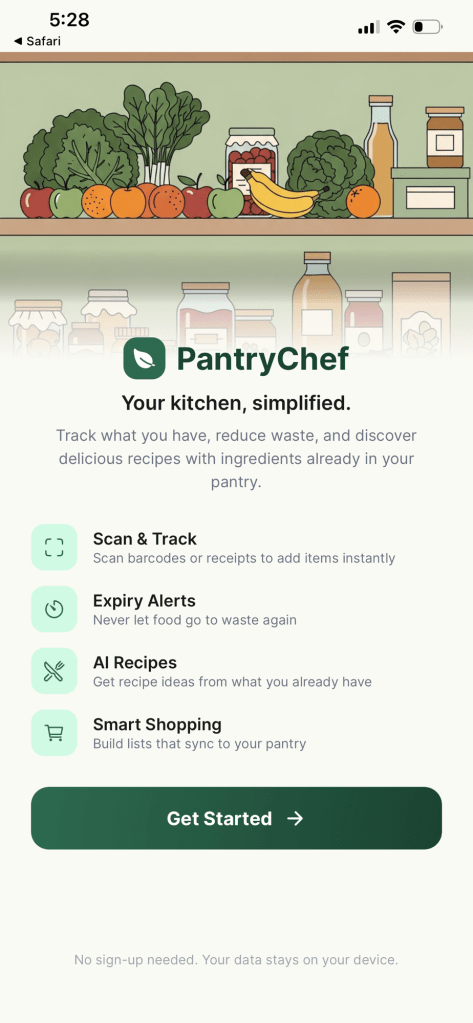
A few hours later, with me coaching, we built PantryChef — a fully functional iPhone app with barcode scanning to add pantry items, expiry date alerts so nothing goes to waste, AI-powered recipe suggestions based on what’s actually in your kitchen, and smart shopping lists that sync to your pantry inventory. It has a polished landing page. It has a clean UI with illustrated pantry shelves and a “Get Started” button. It looks like something a design team might have spent weeks on a few years ago.
She did this in an afternoon. With no technical training. On her first try.
If that doesn’t reframe what’s possible right now, I don’t know what will.
This Is Bigger Than Tech — It’s About Opportunity
If you’re entrepreneurial or exploring a career shift, I wrote a previous post about how to start monetizing this moment. Link below. But I want to zoom out even further, because the implications here go beyond professional development.
Think about this in the context of parenting. If you have a kid who’s about to head off to an expensive four-year university to study something tangentially related to technology — or even directly related — sit them down with Replit and Claude first. Not instead of college necessarily, but before you write that tuition check. Let them spend a weekend building something. Let them see what’s possible with nothing more than a clear description and a few hours. At the very least, they can test-drive their occupational preferences.
Because the door is wide open right now. It opened sometime last fall, quietly, without a press conference or a launch event. The tools caught up to the promise. The interfaces became human. The agents learned to manage themselves.
Maybe some training would help you walk through that door more confidently. But the training I’m talking about isn’t a semester. It’s a Saturday afternoon. It’s a conversation with an AI about something you care about building.
The technology is ready. The question is whether we’re ready to believe it.
Jump in. Describe something. Build it. You’ll be surprised how far a clear idea takes you.

 Better Places